
The Voting News Daily: Kloppenburg campaign raises ballot bag security concern in Waukesha County recount, Omaha World-Herald Sells interest in ES&S

WI: Kloppenburg campaign raises ballot bag security concern in Waukesha County recount – JSOnline

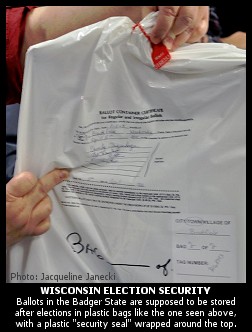
An observer for Assistant Attorney General JoAnne Kloppenburg objected Thursday to the security of bags holding Supreme Court ballots from the City of Brookfield because of a gap opening on the ballot bags. They’ve raised similar objections four or five times in Waukesha County since the start of the recount, said retired Circuit Court Judge Robert Mawdsley, who’s overseeing the county recount. In an interview, he agreed with objector Bill Hotz’s observation that the bag opening from Brookfield was the largest seen so far. Hotz said poorly sealed bags or torn bags appear to be a common problem, but they were evident on five of six Brookfield bags that were counted first thing Thursday. He objected to the counting of those ballots where bags appeared to be open. Brandon O’Bryon, representing Justice David Prosser, objected to the objection, saying Brookfield voters would be disenfranchised if their votes weren’t counted. As has been the practice from the start, Mawdsley makes a record of the concerns and each objection should a challenge end up in court. “There are several bags that appear to be improperly sealed,” Mawdsley said for the record. Kloppenburg’s campaign representatives took pictures of the bags in question. The Board of Canvassers agreed to count the votes, which can be identified separately if necessary. Brookfield City Clerk Kristine Schmidt said that bags filled with too many ballots tend to tear when they’re picked up. She also said that on bags that she personally seals, she threads the seal through additional holes she makes in the bags so they can be pulled tightly shut and stay that way. Not every poll worker does that, and when the bags are lifted, a gap can open up. She also testified, “I guarantee you these ballots were put in (a vault in her office) and not tampered with until they left city hall.” She said a highway worker took the ballots to the courthouse the day after the election. Full Article

Omaha World-Herald sells interest in Election Systems and Software (ES&S) – Omaha.com

The Omaha World-Herald Co. has sold its minority interest in Election Systems & Software Inc., an Omaha company that is the world’s largest election technology company, to McCarthy Group of Omaha and the election company’s management. Terms of the private sale were not disclosed. McCarthy Capital, a private equity investment company, already was a minority stockholder of Election Systems’ stock and is now the majority stockholder, said Michael McCarthy, chairman of McCarthy Group. Election Systems’ management and another independent investor are minority stockholders. World-Herald President and CEO Terry Kroeger said The World-Herald, an investor in Election Systems for nearly 25 years, is proud of what Election Systems accomplished for its shareholders and of its “contributions to our country’s ability to conduct free and fair elections.” Kroeger said the sale strengthens The World-Herald’s balance sheet, providing greater liquidity to the company and its shareholders. Full Article
The Voting News Daily: Wisconsin Recount Mess, Vancouver approves Internet voting

WI: Wisconsin’s Supreme Court Election ‘Recount’ is a Mess – The Brad Blog

Where Minnesota’s post-election hand count of the 2008 U.S. Senate election between then Sen. Norm Coleman and now Sen. Al Franken was, as we wrote at the UK’s Guardian at the time, “one of the longest and most transparent election hand-counts in the history of the US,” Wisconsin has made it extremely difficult (putting it nicely) to know what the hell is actually going on in their statewide “recount” of the April 5th, 2011, state Supreme Court election between Justice David Prosser and Asst. Attorney General JoAnne Kloppenburg. Where Minnesota’s chief election official, Sec. of State Mark Ritchie, oversaw a process to ensure that updated and accurate numbers were easily tracked and transparently shared with the media on a daily basis, Wisconsin’s chief election authority, their Government Accountability Board (G.A.B.), has posted (and even sometimes removed) confusing, misleading, and unclear updates, often with inaccurate information, on various schedules, and frequently with little or no explanation for wholesale changes and deletion of data. Where Minnesota counted every vote by hand with full public scrutiny, including photographs and video cameras, Wisconsin is tabulating ballots, often by the same oft-failed, easily-manipulated computer systems that counted them in the first place, behind barriers that preclude broad public oversight, under an agreement between both campaigns which disallows the use of video cameras by observers. The count, which began last Wednesday, often feels as if it’s happening in virtual darkness, at least to those of us trying to observe from afar, but the same sentiment has been shared with us by many we’ve spoken to who are there on the ground. There is an alarming lack of transparency to help the citizenry oversee the process in order to ensure accountability and an accurate count. To make matters worse, if that’s possible, chain of custody issues for the ballots appear questionable in a number of reported cases, after ballots have been kept in the same darkness by election officials — sometimes securely, sometimes not — for the three weeks following the election and prior to the “recount.” Read More

Canada: Vancouver approves Internet voting in advanced civic election polls – Vancouver Sun

On Tuesday the Vancouver city council approved in principle a pilot project to allow online voters to cast ballots in the advance polls for the Nov. 19 civic election. In a 10-1 vote, council said the benefits — increased voter turnout, elimination of lineups and less costly elections — far outweigh some of the potential downsides, including the potential for stolen voter packages, technical difficulties and hacking attacks and difficulty in identifying voter identification. “I totally appreciate for some that voting online is a totally, totally strange thing to do,” said Coun. Andrea Reimer, who wants to see more of the city’s business done online. “To my mind there are risks to online voting but there are also risks to have so few people voting. It isn’t about forcing anyone to vote online but to give people choices.”

Wisconsin: Wisconsin’s Supreme Court Election ‘Recount’ is a Mess | The Brad Blog

Wisconsin is no Minnesota. Where Minnesota’s post-election hand count of the 2008 U.S. Senate election between then Sen. Norm Coleman and now Sen. Al Franken was, as we wrote at the UK’s Guardian at the time, “one of the longest and most transparent election hand-counts in the history of the US,” Wisconsin has made it extremely difficult (putting it nicely) to know what the hell is actually going on in their statewide “recount” of the April 5th, 2011, state Supreme Court election between Justice David Prosser and Asst. Attorney General JoAnne Kloppenburg.

Where Minnesota’s chief election official, Sec. of State Mark Ritchie, oversaw a process to ensure that updated and accurate numbers were easily tracked and transparently shared with the media on a daily basis, Wisconsin’s chief election authority, their Government Accountability Board (G.A.B.), has posted (and even sometimes removed) confusing, misleading, and unclear updates, often with inaccurate information, on various schedules, and frequently with little or no explanation for wholesale changes and deletion of data.

Wisconsin: Wisconsin Voter ID bill criticized by head of Government Accountability Board for deterring student voters | The Daily Cardinal

As the Assembly Committee on Election and Campaign Reform passed the Voter ID bill on partisan lines, Government Accountability Board Director Kevin Kennedy criticized it for creating administrative hassle and deterring student voters. The latest draft of the Voter ID bill allows the use of a student ID from an accredited university or college to vote provided that it has a current address, date of birth and signature on it. Few student IDs meet these requirements.

“This is a demographic that has the lowest voter participation rate of all age groups,” Kennedy said in the letter. “In order to cultivate engaged, active citizens, we need to facilitate voting among our youth rather than imposing artificial barriers to participation.”

Oklahoma: Oklahoma State Supreme Court won’t take suit challenging voter ID law | Tulsa World

The State Supreme Court has declined to intervene in a Tulsa County lawsuit that must be moved to Oklahoma County for it to proceed with its challenge to a voter-approved state question.

In an order Monday, the Supreme Court denied a request for it to take jurisdiction over a suit challenging SQ 746, the voter identification issue. SQ 746 is scheduled to take effect July 1. It was approved Nov. 2, drawing 74 percent voter approval.

Rhode Island: Rhode Island Senate panel OKs DNA, voter ID bills | The Providence Journal

Two bills concerning a person’s true identity were approved by the Senate Judiciary Committee Tuesday afternoon. One would require taking DNA samples from people charged with violent crimes. The other would require poll workers to check the photo IDs of voters, starting with the 2012 election season.

The voter ID bill, sponsored by Sen. Harold M. Metts, D-Providence, was also approved, despite some dissent. Providence Democrat Rhoda E. Perry called the bill a “solution to a non-problem,” adding that requiring people to show a photo ID or some form of identification at the polls would discourage them from voting, especially the poor and elderly. Perry and committee Vice Chairman Paul V. Jabour, D-Providence, voted against the bill.

North Carolina: North Carolina Senate bill seeks to cripple one-stop early voting | The Wilmington Journal

A Republican-sponsored NC Senate bill, SB 657, has been introduced that, if enacted, would severely cripple the state’s One Stop Early Voting/Same-day Voter Registration law that helped President Barack Obama win North Carolina in 2008. Indeed, the bill would eliminate same-day registration, an important tool of voter empowerment for communities of color, proponents say.

The goal, critics say, is to make the 2012 presidential election harder for Obama and the Democrats to win. Coupled with GOP control of redistricting, and the party’s legislative push for voter ID which critics like the NC NAACP charge is an attempt at voter suppression of black and Hispanic voters, attorney Irving Joyner, chair of the NCNAACP’s Legal Redress Committee, says SB 657 must be opposed.

New Hampshire: New Hampshire voters may soon need ID at polls | EagleTribune.com

A proposal to require voters to present a photo ID at the polls has town clerks worried it could create a nightmare during elections. The state House of Representatives is expected to vote today on legislation intended to prevent election fraud. While some election workers think it’s a good idea, they say they are concerned about “provisional balloting.” That would give people three days to present their ID if they don’t have it when they go to the polls.

“That would hold up the election count for days,” Plaistow Town Clerk Maryellen Pelletier said yesterday. Voters should have to show their IDs at the polls, Pelletier said, but she opposes provisional balloting. Other Southern New Hampshire officials also disagree with the provision, including Derry Town Clerk Denise Neale. “That is really going to mess up our system,” she said. “There are too many questions involved.”

Minnesota: Minnesota Voter ID opponents say litigation a possibility | MinnPost

94-year-old Mary Lou Hill shown expressing her opposition to various Voter ID bills.Opponents of a group of Voter ID measures in the Minnesota House and Senate — including one that could lead to a constitutional amendment initiative — are not going to go away quietly.

Representatives of more than 20 nonprofit groups held a news conference today to make their case that, among others, students, seniors, homeless people and people who don’t drive would find themselves on the outside looking in when it comes to voting because of a Republican-sponsored Voter ID requirement moving quickly through legislative committees. One thing is certain: Passage of any bill could bring litigation.

Canada: Vancouver Canada approves Internet voting in advanced civic election polls | Vancouver Sun

Vancouver, one of the first municipalities in Canada to bring in electronic ballot-counting machines, is moving into the next generation of digital democracy: online voting.

On Tuesday city council approved in principle a pilot project to allow online voters to cast ballots in the advance polls for the Nov. 19 civic election.In a 10-1 vote, council said the benefits — increased voter turnout, elimination of lineups and less costly elections — far outweigh some of the potential downsides, including the potential for stolen voter packages, technical difficulties and hacking attacks and difficulty in identifying voter identification.

The Voting News Daily: Nelson blasts Florida election-law fixes, Report shows that 1 in 6 recounts changed results

FL: Nelson blasts Florida Legislature’s 2012 election-law fixes – Legislature – MiamiHerald.com

Democratic U.S. Sen. Bill Nelson blasted state Republican lawmakers Monday for an election law overhaul that he says will block college students and military personnel from having their votes counted next year when he and President Barack Obama both seek re-election. Then Nelson waded into a controversy of his own when he suggested the U.S. special forces that killed al-Qaida leader Osama bin Laden could be blocked from voting if the Legislature passes the bill. “Should we deny those very military that carried out this very successful decapitating of the al-Qaida snake?” Nelson asked at a Capitol news conference. “Should we deny them because they have signed their voter registration card in a different way than they signed their absentee ballot overseas?” Full Article

Report: Recounts rarely impact state elections | California Watch

Between 2000 and 2009, recounts in state elections were extremely uncommon and rarely resulted in reversals when they did happen, according to a new study [PDF] by the Center for Voting and Democracy. Out of 2,884 statewide general elections there were 18 recounts, only three of which resulted in a change in decision. “There are people who have been pretty critical of the way that we do a lot of voting, thinking it could be done better. But at the same time the basic function of tallying ballots once the voter gets them to their poll worker or the machine, it seems to actually be doing well,” said Robert Richie, co-author of the study. … Having an automatic recount procedure for a race won by 0.5 percent, that’s way too high, absent some reason to think that there’s something that was systematically done in error or fraud.”

But Pamela Smith, president of Verified Voting, said the systems used in many states can’t be recounted because of their design. And even where recountable systems are used, fraud and error can easily go undetected if a race is not close enough to merit a recount. “You’ve got 18 recounts out of close to 3,000 contests, three of which resulted in decisions being reversed,” she said. “Well, three isn’t a large percentage out of 3,000, but it’s a sixth of 18. If those are the only cases that you’re doing a recount in, I think you have to look at that.” Californians have been nothing if not skeptical when it comes to using electronic machines and adopting methods like ranked-choice voting. But Smith said California is ahead of the curve when it comes to many of these issues. The state has been conducting a baseline manual tally of 1 percent of precincts in every county for decades. And in 2007, California Secretary of State Debra Bowen commissioned a “top-to-bottom review” of voting systems and created a Post Election Audit Standards Working Group [PDF]. California also recently passed legislation launching a “risk-limiting audit” program to increase the scrutiny of electronic voting machines, which is something that Richie calls for in the study.

California: Report shows 1 in 6 recounts changed election results in the last decade | California Watch

Between 2000 and 2009, recounts in state elections were extremely uncommon and rarely resulted in reversals when they did happen, according to a new study [PDF] by the Center for Voting and Democracy. Out of 2,884 statewide general elections there were 18 recounts, only three of which resulted in a change in decision. …

“Having an automatic recount procedure for a race won by 0.5 percent, that’s way too high, absent some reason to think that there’s something that was systematically done in error or fraud.” But Pamela Smith, president of Verified Voting, said the systems used in many states can’t be recounted because of their design. And even where recountable systems are used, fraud and error can easily go undetected if a race is not close enough to merit a recount.

Wisconsin: Local vote totals change in Supreme recount in Wisconsin | GazetteXtra

Justice David Prosser gained 10 votes in the recount of Rock County ballots for the state Supreme Court race. Challenger JoAnne Kloppenburg, meanwhile, gained 47 votes. Rock County Clerk Lori Stottler said those are the preliminary results of the local recount of the April 2 vote. The recount was completed Monday.

Most precincts where errors were found had only one or two changes, Stottler said. Orfordville had the most with seven. Stottler said the problem in Orfordville might have been that the voting machine was not properly calibrated, so it was not reading votes correctly.

Guam: Early in-office voting, machines debated in Guam | Pacific Daily News

Lawmakers yesterday debated two bills that could affect future island elections — ending the recently approved process for early in-office voting and paving the way for the return of controversial electronic voting machines. Lawmakers debated another election bill by Respicio, which would allow for the use of electronic voting machines, provided the machines print a “voter-verified paper ballot” which the voter can double-check before placing into a ballot box.

Respicio in 2006 wrote a law banning the use of electronic voting machines until several conditions are met, including training and safeguards for accuracy. The Election Commission spent nearly half a million dollars in federal election assistance funding to buy 116 Ivotronic electronic voting machines, according to Pacific Daily News files.

National: ES&S and Scytl Announce Strategic Alliance to Provide a Military and Overseas Electronic Voting Solution (ES&S Press Release) | MarketWatch

Election Systems & Software, Inc. (ES&S) and Scytl today announced a strategic alliance that will provide for BALLOTsafe, a fully integrated online ballot delivery and marking system that will afford military, overseas, absentee and disabled voters the opportunity to cast ballots in a timely, secure and reliable manner.

By combining the market proven election leadership of ES&S with the secure cryptographic online platform pioneered by Scytl, this alliance allows states and local jurisdictions the ability to seamlessly and effortlessly integrate the ballot creation process with the ballot delivery process making BALLOTsafe the leader in voting technology for military, overseas, absentee and disabled voters.

Canada: Q and A-How will Canada election work? What are the rules? | Reuters

Canada is holding a federal election on Monday. Here are the main points of how the country’s electoral system works:

What exactly will happen on Monday? Canada has two houses of Parliament — the elected House of Commons and the unelected upper chamber, the Senate, where members are appointed by the government. Monday’s election is for seats in the much more powerful House of Commons. Canada is divided up into 308 electoral districts known as ridings, each of which elects a member of the House.

India: India: The Concept of Negative Voting |The Sentinel

The reality of today’s electoral democracy is that in many constituencies the voters are discontented with the candidates in the electoral fray. Hence the demand for negative voting. In India, the largest democracy in the world, it is not only expected of the voters to exercise their constitutional right to vote, but it is also their ardent duty. And even though voting is not yet mandatory, the Election Commission of India on its part pro-actively informs all the voters to cast their vote by giving wide publicity towards this end. After all, every vote counts.

But if the voters decide that none of the candidates is worth their vote, what is the way out? In the case where Electronic Voting Machines (EVMs) are in use, The Conduct of Elections Rule, 1961, does provide a voter the option to refuse to vote after he has been identified and necessary entries made in the register of electors and in the marked copy of the electoral roll.

Florida: Nelson blasts Florida Legislature’s 2012 election-law fixes | MiamiHerald.com

Democratic U.S. Sen. Bill Nelson blasted state Republican lawmakers Monday for an election law overhaul that he says will block college students and military personnel from having their votes counted next year when he and President Barack Obama both seek re-election.

Then Nelson waded into a controversy of his own when he suggested the U.S. special forces that killed al-Qaida leader Osama bin Laden could be blocked from voting if the Legislature passes the bill.

Arizona: New concerns raised over Tucson all mail election | Fox 11-KMSB Tucson

When voting this year, residents won’t be heading to the polls. Weeks ago, Tucson’s city council voted to make the switch to an all vote by mail election. It was a decision that stirred up controversy.

But news of missing mail ballots in Sahuarita is causing concern. On April 5 the council weighed whether or not Tucson can handle an all mail election. And after hearing from the public, council members decided the answer was yes, an all vote by mail election was the best way to go.

The Voting News Daily: Misplaced Ballots in Arizona and Wisconsin

AZ: Ballots ‘misplaced,’ raising concern over all-mail vote – Arizona Daily Star

The U.S. Postal Service “misplaced” about 85 mail-in ballots for an upcoming all-mail election in Sahuarita, Pima County Recorder F. Ann Rodriguez said Friday. While replacing the ballots was relatively easy for a smaller-city election, the incident is raising questions about the Tucson City Council’s recent decision to switch to all-mail voting. This is the first time the Recorder’s Office has heard of the Postal Service losing ballots, said Rodriguez. The disappearance of what “appears to be a single mail tray” of ballots was discovered when voters, all in the same section of the Quail Creek neighborhood, started reporting they hadn’t received theirs a week after they were mailed out. Just over 12,000 ballots were mailed to Sahuarita voters on April 21. So far, 85 voters have requested replacements. Rodriguez said the problem appears to be limited to “a single tray” of ballots intended for that neighborhood. With 1.6 million mail-in ballots sent in Pima County over the last decade, “this is a very rare occurrence,” she said. Postal workers “haven’t found any evidence that any mail was misplaced,” said Robert Soler, a spokesperson with the U.S. Postal Service in Tucson. Still, both Soler and Rodriguez urged voters to call the Recorder’s Office if they hadn’t received a ballot and they would be mailed before the election on May 17. “The voters have been issued second ballots and we have taken care of them,” Rodriguez said, who added that measures are in place to make sure there would be only one vote per person. Full Article

WI: Missing Verona ballots cause glitch in Supreme Court race recount – madison.comt

Newly appointed Dane County Clerk Karen Peters initially had doubts that the county could finish hand counting some 182,000 Supreme Court ballots within a 13-day deadline. But on Thursday she expressed confidence that it could be done. But that was before the glitch. On Thursday afternoon official “tabulators” were busily counting ballots from the city of Verona when the votes came up more than 90 short of what the electronic readout from the voting machines said they should. That sent Verona officials on a hunt, and a rubber-banded stack of 97 ballots turned up in the office of Verona City Clerk Judy Masarik. “There’s a table in the clerk’s office, and there was a binder and some other papers on top of the ballots,” said City Administrator Bill Burns, who found the stack. The statewide recount, requested by challenger JoAnne Kloppenburg after her narrow loss to incumbent David Prosser, has the potential to change the outcome, so the Verona situation caused much consternation. On election night, all the ballots were supposed to be secured in sealed bags, which were then supposed to be signed by local elections officials. The seals were supposed to remain intact. Full Article

Arizona: Arizona: ‘Misplaced’ ballots raising concern over all-mail vote – Arizona Daily Star

The U.S. Postal Service “misplaced” about 85 mail-in ballots for an upcoming all-mail election in Sahuarita, Pima County Recorder F. Ann Rodriguez said Friday. While replacing the ballots was relatively easy for a smaller-city election, the incident is raising questions about the Tucson City Council’s recent decision to switch to all-mail voting. This is the first time the Recorder’s Office has heard of the Postal Service losing ballots, said Rodriguez.

The disappearance of what “appears to be a single mail tray” of ballots was discovered when voters, all in the same section of the Quail Creek neighborhood, started reporting they hadn’t received theirs a week after they were mailed out.Just over 12,000 ballots were mailed to Sahuarita voters on April 21. So far, 85 voters have requested replacements.Rodriguez said the problem appears to be limited to “a single tray” of ballots intended for that neighborhood. With 1.6 million mail-in ballots sent in Pima County over the last decade, “this is a very rare occurrence,” she said.

Hawaii: Hawaii lawmakers table runoff-voting bill | Staradvertiser.com

A proposal to impose “instant runoff” voting in county elections has been tabled at the state Legislature this year. House and Senate members decided late Thursday night to defer the measure.

“We got some late information on the cost,” said Rep. Gil Keith-Agaran, the House Judiciary Chairman and lead negotiator on the bill. “I think we’d like to take this up during the interim and consider maybe bringing it back next year.”

Wisconsin: Missing ballots in Verona Wisconsin cause glitch in Supreme Court race recount | The Capital Times

On Thursday afternoon official “tabulators” were busily counting ballots from the city of Verona when the votes came up more than 90 short of what the electronic readout from the voting machines said they should. That sent Verona officials on a hunt, and a rubber-banded stack of 97 ballots turned up in the office of Verona City Clerk Judy Masarik.

“There’s a table in the clerk’s office, and there was a binder and some other papers on top of the ballots,” said City Administrator Bill Burns, who found the stack. The statewide recount, requested by challenger JoAnne Kloppenburg after her narrow loss to incumbent David Prosser, has the potential to change the outcome, so the Verona situation caused much consternation. On election night, all the ballots were supposed to be secured in sealed bags, which were then supposed to be signed by local elections officials. The seals were supposed to remain intact. Burns found the bundle unbagged. They were bagged and he drove them to Madison. The bag had no signatures or initials.

Wisconsin: Kloppenburg Campaign Calls in Attorney to Monitor Recount | TMJ4 – Milwaukee

On Friday, day three of the statewide recount of the Supreme Court race, the Kloppenburg recall effort called in their attorney, Michael Maistelman, to monitor the recount in Waukesha County.
Earlier Friday a clerk discovered that one of the bags full of ballots from the Town of Delafield was not properly sealed.  The Kloppenburg campaign said that means there was the possibility that people could have had access to the bag of ballots.  On Thursday, a different bag containing hundreds of ballots wasn’t recorded on the poll inspector’s log.  That bag was also from the Town of Delafield.

Zambia: UK to pump K48.5b into Electoral Commission of Zambia | LusakaTimes.com

http://www.lusakatimes.com/wp-content/uploads/2009/10/ecz.jpegThe British government will spend 48.5 Billion Kwacha to help the Electoral Commission of Zambia (ECZ) deliver free and fair elections during this year’s polls.

British High Commissioner to Zambia Tom Carter says part of the money will also go towards enhancing democracy in the country. Mr Carter says the assistance which will be done through the United Nations Development Programme (UNDP) will involve training of police officers to enable them handle elections in an effective manner.

The Voting News Daily: The Democracy Theater of Online Voting, Tennessee Needs Paper Ballots

CT: Online voting is risky and expensive | The Connecticut Mirror

Online voting is an appealing option to speed voting for military and overseas voters. Yet it is actually “Democracy Theater”, providing an expensive, risky illusion of supporting our troops. Technologists warn of the unsolved technical challenges, while experience shows that the risks are tangible and pervasive. There are safer, less expensive solutions available. This year, the Government Administration and Elections Committee held hearings on a bill for online voting for military voters. Later they approved a “technical bill”, S.B. 939. Tucked at the end was a paragraph requiring that the Secretary of the State “shall, within available appropriations, establish a method to allow for on-line voting by military personnel stationed out of state.” In 2008, over thirty computer scientists, security experts and technicians signed the “Computer Technologists’ Statement on Internet Voting,” listing five unsolved technical challenges and concluding: “[W]e believe it is necessary to warn policymakers and the public that secure internet voting is a very hard technical problem, and that we should proceed with internet voting schemes only after thorough consideration of the technical and non-technical issues in doing so.” Full Article

TN: Tennessee needs reliable paper ballots – The Tennessean

Now The Tennessean reports that this session of the state legislature may repeal the never-implemented Tennessee Voter Confidence Act (April 25). It was the fine work of an earlier session to give us this law. It is a reliable system of voting that requires the use of paper ballots for a possible real check on the accuracy of the electronic vote if and when it becomes necessary. This is quite impossible with the system that Tennessee has been using, which relies totally on electronic voting machines without paper ballots. These machines have been shown in many different places to be subject to large errors or even deliberate manipulation. There is no way to verify an election with these delicate machines. The present Tennessee law requiring a paper ballot record of every vote as counted by electronic counters was passed years ago. It had the strong support of most legislators, Republican and Democrat, but the law’s implementation has been deferred until the 2012 election. Some in this legislature are bent on repeal of the law, claiming that it will cost too much. But Tennessee for years has had money in the bank from the federal government which covers the full cost of the new equipment. Full Article

Editorials: Thomas Bates: Why Photo ID Laws Are Not the Answer | Huffington Post

We hear it all the time: How can you be against making voters show a photo ID when they vote? You need an ID to do almost anything in today’s society — buying beer, driving a car, getting on an airplane, going to an R-rated movie — so why shouldn’t you have to show a government-issued photo ID to vote?

It sure sounds like common sense, and it is a sentiment, coupled with the specter of voter fraud, that has driven more than 30 state legislatures this year to consider requiring limited forms of government-issued photo ID at the polls, prompting the Washington Post and New York Times to question why the country is fighting what is essentially a war on voting.

The rub: Strict photo ID laws result in disenfranchisement, unnecessary costs, and unequal treatment of voters and simply are not a proportionate response to any legitimate concerns about potential voter fraud. What may seem like common sense is actually a real barrier for those who want to participate, and a significant expense to all of us.

Wisconsin: JoAnne Kloppenburg says anomalies were widespread during the state Supreme Court race | PolitiFact Wisconsin

Wisconsin Supreme Court candidate JoAnne Kloppenburg declared victory on election night when preliminary, unofficial returns put her 204 votes ahead of Justice David Prosser. Fifteen days later, she sought a statewide recount after the official county-by-county returns showed her trailing by more than 7,300 votes out of 1.5 million cast.

In explaining her decision, Kloppenburg told reporters that a recount may not get her over the top, but would shine a light on “an election that right now seems to so many people to be suspect.” She also went on the offensive, raising questions about the legitimacy of the vote count around the state. “There are legitimate and widespread anomalies,” said Kloppenburg, a state Justice Department attorney, “and widespread questions about the conduct of this election, most visibly in Waukesha County, but also in counties around the state.”

Editorials: Tennessee needs reliable paper ballots | The Tennessean

Now The Tennessean reports that this session of the state legislature may repeal the never-implemented Tennessee Voter Confidence Act (April 25). It was the fine work of an earlier session to give us this law. It is a reliable system of voting that requires the use of paper ballots for a possible real check on the accuracy of the electronic vote if and when it becomes necessary.

This is quite impossible with the system that Tennessee has been using, which relies totally on electronic voting machines without paper ballots. These machines have been shown in many different places to be subject to large errors or even deliberate manipulation. There is no way to verify an election with these delicate machines.