
The Voting News Daily: Wisconsin Recount Mess, Vancouver approves Internet voting

WI: Wisconsin’s Supreme Court Election ‘Recount’ is a Mess – The Brad Blog

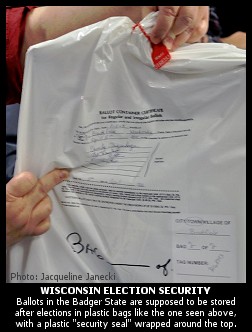
Where Minnesota’s post-election hand count of the 2008 U.S. Senate election between then Sen. Norm Coleman and now Sen. Al Franken was, as we wrote at the UK’s Guardian at the time, “one of the longest and most transparent election hand-counts in the history of the US,” Wisconsin has made it extremely difficult (putting it nicely) to know what the hell is actually going on in their statewide “recount” of the April 5th, 2011, state Supreme Court election between Justice David Prosser and Asst. Attorney General JoAnne Kloppenburg. Where Minnesota’s chief election official, Sec. of State Mark Ritchie, oversaw a process to ensure that updated and accurate numbers were easily tracked and transparently shared with the media on a daily basis, Wisconsin’s chief election authority, their Government Accountability Board (G.A.B.), has posted (and even sometimes removed) confusing, misleading, and unclear updates, often with inaccurate information, on various schedules, and frequently with little or no explanation for wholesale changes and deletion of data. Where Minnesota counted every vote by hand with full public scrutiny, including photographs and video cameras, Wisconsin is tabulating ballots, often by the same oft-failed, easily-manipulated computer systems that counted them in the first place, behind barriers that preclude broad public oversight, under an agreement between both campaigns which disallows the use of video cameras by observers. The count, which began last Wednesday, often feels as if it’s happening in virtual darkness, at least to those of us trying to observe from afar, but the same sentiment has been shared with us by many we’ve spoken to who are there on the ground. There is an alarming lack of transparency to help the citizenry oversee the process in order to ensure accountability and an accurate count. To make matters worse, if that’s possible, chain of custody issues for the ballots appear questionable in a number of reported cases, after ballots have been kept in the same darkness by election officials — sometimes securely, sometimes not — for the three weeks following the election and prior to the “recount.” Read More

Canada: Vancouver approves Internet voting in advanced civic election polls – Vancouver Sun

On Tuesday the Vancouver city council approved in principle a pilot project to allow online voters to cast ballots in the advance polls for the Nov. 19 civic election. In a 10-1 vote, council said the benefits — increased voter turnout, elimination of lineups and less costly elections — far outweigh some of the potential downsides, including the potential for stolen voter packages, technical difficulties and hacking attacks and difficulty in identifying voter identification. “I totally appreciate for some that voting online is a totally, totally strange thing to do,” said Coun. Andrea Reimer, who wants to see more of the city’s business done online. “To my mind there are risks to online voting but there are also risks to have so few people voting. It isn’t about forcing anyone to vote online but to give people choices.”
Wisconsin: Wisconsin’s Supreme Court Election ‘Recount’ is a Mess | The Brad Blog

Wisconsin is no Minnesota. Where Minnesota’s post-election hand count of the 2008 U.S. Senate election between then Sen. Norm Coleman and now Sen. Al Franken was, as we wrote at the UK’s Guardian at the time, “one of the longest and most transparent election hand-counts in the history of the US,” Wisconsin has made it extremely difficult (putting it nicely) to know what the hell is actually going on in their statewide “recount” of the April 5th, 2011, state Supreme Court election between Justice David Prosser and Asst. Attorney General JoAnne Kloppenburg.

Where Minnesota’s chief election official, Sec. of State Mark Ritchie, oversaw a process to ensure that updated and accurate numbers were easily tracked and transparently shared with the media on a daily basis, Wisconsin’s chief election authority, their Government Accountability Board (G.A.B.), has posted (and even sometimes removed) confusing, misleading, and unclear updates, often with inaccurate information, on various schedules, and frequently with little or no explanation for wholesale changes and deletion of data.

Wisconsin: Wisconsin Voter ID bill criticized by head of Government Accountability Board for deterring student voters | The Daily Cardinal

As the Assembly Committee on Election and Campaign Reform passed the Voter ID bill on partisan lines, Government Accountability Board Director Kevin Kennedy criticized it for creating administrative hassle and deterring student voters. The latest draft of the Voter ID bill allows the use of a student ID from an accredited university or college to vote provided that it has a current address, date of birth and signature on it. Few student IDs meet these requirements.

“This is a demographic that has the lowest voter participation rate of all age groups,” Kennedy said in the letter. “In order to cultivate engaged, active citizens, we need to facilitate voting among our youth rather than imposing artificial barriers to participation.”

Oklahoma: Oklahoma State Supreme Court won’t take suit challenging voter ID law | Tulsa World

The State Supreme Court has declined to intervene in a Tulsa County lawsuit that must be moved to Oklahoma County for it to proceed with its challenge to a voter-approved state question.

In an order Monday, the Supreme Court denied a request for it to take jurisdiction over a suit challenging SQ 746, the voter identification issue. SQ 746 is scheduled to take effect July 1. It was approved Nov. 2, drawing 74 percent voter approval.

Rhode Island: Rhode Island Senate panel OKs DNA, voter ID bills | The Providence Journal

Two bills concerning a person’s true identity were approved by the Senate Judiciary Committee Tuesday afternoon. One would require taking DNA samples from people charged with violent crimes. The other would require poll workers to check the photo IDs of voters, starting with the 2012 election season.

The voter ID bill, sponsored by Sen. Harold M. Metts, D-Providence, was also approved, despite some dissent. Providence Democrat Rhoda E. Perry called the bill a “solution to a non-problem,” adding that requiring people to show a photo ID or some form of identification at the polls would discourage them from voting, especially the poor and elderly. Perry and committee Vice Chairman Paul V. Jabour, D-Providence, voted against the bill.

North Carolina: North Carolina Senate bill seeks to cripple one-stop early voting | The Wilmington Journal

A Republican-sponsored NC Senate bill, SB 657, has been introduced that, if enacted, would severely cripple the state’s One Stop Early Voting/Same-day Voter Registration law that helped President Barack Obama win North Carolina in 2008. Indeed, the bill would eliminate same-day registration, an important tool of voter empowerment for communities of color, proponents say.

The goal, critics say, is to make the 2012 presidential election harder for Obama and the Democrats to win. Coupled with GOP control of redistricting, and the party’s legislative push for voter ID which critics like the NC NAACP charge is an attempt at voter suppression of black and Hispanic voters, attorney Irving Joyner, chair of the NCNAACP’s Legal Redress Committee, says SB 657 must be opposed.

New Hampshire: New Hampshire voters may soon need ID at polls | EagleTribune.com

A proposal to require voters to present a photo ID at the polls has town clerks worried it could create a nightmare during elections. The state House of Representatives is expected to vote today on legislation intended to prevent election fraud. While some election workers think it’s a good idea, they say they are concerned about “provisional balloting.” That would give people three days to present their ID if they don’t have it when they go to the polls.

“That would hold up the election count for days,” Plaistow Town Clerk Maryellen Pelletier said yesterday. Voters should have to show their IDs at the polls, Pelletier said, but she opposes provisional balloting. Other Southern New Hampshire officials also disagree with the provision, including Derry Town Clerk Denise Neale. “That is really going to mess up our system,” she said. “There are too many questions involved.”

Minnesota: Minnesota Voter ID opponents say litigation a possibility | MinnPost

94-year-old Mary Lou Hill shown expressing her opposition to various Voter ID bills.Opponents of a group of Voter ID measures in the Minnesota House and Senate — including one that could lead to a constitutional amendment initiative — are not going to go away quietly.

Representatives of more than 20 nonprofit groups held a news conference today to make their case that, among others, students, seniors, homeless people and people who don’t drive would find themselves on the outside looking in when it comes to voting because of a Republican-sponsored Voter ID requirement moving quickly through legislative committees. One thing is certain: Passage of any bill could bring litigation.

Canada: Vancouver Canada approves Internet voting in advanced civic election polls | Vancouver Sun

Vancouver, one of the first municipalities in Canada to bring in electronic ballot-counting machines, is moving into the next generation of digital democracy: online voting.

On Tuesday city council approved in principle a pilot project to allow online voters to cast ballots in the advance polls for the Nov. 19 civic election.In a 10-1 vote, council said the benefits — increased voter turnout, elimination of lineups and less costly elections — far outweigh some of the potential downsides, including the potential for stolen voter packages, technical difficulties and hacking attacks and difficulty in identifying voter identification.