Zimbabwe: Zimbabwe too broke to organise elections this year | Daily Nation

Zimbabwe's Finance Minister Tendai Biti addresses a news conference at the party's headquarters in Harare May 6, 2009. He has said Zimbabwe does not have the $400 million needed to organise elections this year  Photo/FILE

Zimbabwe's Finance Minister Tendai Biti

Zimbabwe does not have the $400 million needed to organise elections this year, Finance minister Tendai Biti has said. Mr Biti said the coalition government also faces a $150 million deficit this year because it had missed all revenue targets with almost half the year gone.

The government has set a revenue target of $2.7 billion this year, but the economy has performed poorly due to the unstable political environment. President Robert Mugabe says he wants an early election because he has failed to work with his rivals in a coalition government formed in 2009 following his disputed re-election a year earlier.

The Voting News Daily: Recount reasonable — just ask a Republican, Politics behind GOP’s voting changes in Florida

WI: Recount reasonable — just ask a Republican – madison.com

Candidates in close races who find themselves contemplating whether to seek a recount of the ballots — and the resolution of related questions about the quality and character of the initial count — need to have some standard for determining when it is reasonable to make the demand. Certainly, if the difference is a handful of votes, no one would argue with seeking a recount. But what about when the margin is larger, such as the 7,316-vote difference between Assistant Attorney General JoAnne Kloppenburg and Justice David Prosser in the hotly contested race for state Supreme Court? Was it unreasonable for Kloppenburg to seek a recount? Not if you ask a Republican.

Back in 1960, when the closest presidential race in modern American history was decided for Democrat John Kennedy, the Republican National Committee and state Republican parties sought recounts in 11 states, including Texas. Kennedy’s advantage over Republican Richard Nixon in Texas in the initial count was 46,000 votes. While Democrats objected that Kennedy’s margin was too large to be overturned, Republicans argued that allegations of voting irregularities in a number of Texas counties justified the demand. Similarly, in the 1976 presidential race, after Democrat Jimmy Carter beat Republican Gerald Ford in Ohio by more than 9,000, Republicans sought a recount of the votes in that state. And just last year in Minnesota’s gubernatorial race, Democrat Mark Dayton led Republican Tom Emmer by a little less than 9,000 votes. A hand recount of the state’s ballots confirmed Dayton’s winning margin was 8,770 votes. Emmer’s campaign and the state Republican Party continued to wage court fights and challenge ballots until more than a month after the election, when Emmer finally conceded. In all three cases, Republicans made reasonable requests for recounts, even if those requests failed to overturn the results.

But Wisconsinites know that recounts can alter results. Full Article

FL: Politics behind GOP’s voting changes | jacksonville.com

If anyone needs a clue as to why the state’s Republican-dominated Legislature is making proposals that puts early voting in its cross hairs, one place to look might be Time magazine’s Oct. 30, 2008 issue. In it was a piece titled “How Early Voting Could Cost McCain Florida.” It detailed how early-voting Democrats, many of them energized by the candidacy of Barack Obama, were outnumbering Republicans at early voting sites by more than 20 percentage points. One professor talked about how early voting rewards campaigns that are better organized because it requires more refined voter-mobilization efforts, and how it makes it easier for everyday people, such as hourly workers, to participate without having to worry about taking time off on Election Day. Indeed, McCain lost Florida. Another presidential election is around the corner. The GOP doesn’t want to risk a repeat of 2008, it seems. That’s the only plausible explanation why lawmakers would concoct laws that are aimed at improving their political fortunes, but not at improving the fortunes of Floridians who are struggling to find jobs in an atmosphere of double-digit unemployment.

North Carolina: GOP proposal would cut a week from early voting | CharlotteObserver.com

Heading into a presidential election in which North Carolina could be pivotal, a new Republican-backed bill would curtail early voting in the state and bar new voters from registering at the polls. The Senate bill introduced last week would shrink the early-voting period by at least a week, end it on Sundays and stop so-called “same-day registration.”

“We were just trying to minimize the time early voting polls were open … so the expense is not so great for local election boards,” Sen. Jim Davis, a Macon County Republican who sponsored the bill, said Monday. “Everybody who wants to vote still can vote.” It’s unclear how much support the bill has, even among Republicans. The bill is still in a Senate committee and has a long way to go before it could become law.

Nevada: Nevada Campaign Finance And Election Reform Bills Win Approval In Assembly By Deadline | Nevada News Bureau

Two bills that would close loopholes and increase transparency in Nevada’s election and campaign finance laws won approval in the Assembly today with no time to spare. Secretary of State Ross Miller is seeking the bills restricting the use of multiple political action committees to bypass campaign contribution limits and requiring electronic filing of campaign contribution and expense reports by most candidates.

Today was the deadline for the bills to win Assembly approval or see no further consideration in the 2011 legislative session. They will now be considered by the Senate.

Indiana: Indiana Secretary of State White wants judge to stop civil challenge to his eligibility | The Indianapolis Star

Charlie White is asking a Marion County judge to temporarily stop Democrats’ challenge to his eligibility to serve as secretary of state. If his request is granted, Democrats’ plan to oust White through a civil complaint could be derailed. They claim he wasn’t legally registered to vote at the time he declared his candidacy and wasn’t eligible to run.

In a motion filed today, White says the civil challenge should be stopped until a criminal case pending in Hamilton County is resolved. White faces seven felony charges, including three counts of voter fraud. Since both cases involve the legality of his voter registration, allowing the civil case to proceed could jeopardize White’s right to not incriminate himself, according to the motion.

Georgia: Georgia election changes suggested | The Augusta Chronicle

Georgia’s election law should be changed to allow more third-party candidates, voting machines with paper records and vetting of presidential hopefuls, according to 19 witnesses at Wednesday’s initial meeting of the Georgia Election Advisory Council.

Secretary of State Brian Kemp, whose office oversees elections, conceived the council and appointed it 15 members of legislators, academics and elections officials. When he first announced it, he said its goal would be to find ideas to save money and improve efficiency. The witnesses said they were looking for more substantive changes. “A lot of these things are going to depend on the will of the legislature,” Kemp said.

Editorials: Tonyaa Weathersbee: Politics behind GOP’s voting changes | jacksonville.com

If anyone needs a clue as to why the state’s Republican-dominated Legislature is making proposals that puts early voting in its cross hairs, one place to look might be Time magazine’s Oct. 30, 2008 issue.

In it was a piece titled “How Early Voting Could Cost McCain Florida.” It detailed how early-voting Democrats, many of them energized by the candidacy of Barack Obama, were outnumbering Republicans at early voting sites by more than 20 percentage points.

Connecticut: Connecticut Lawmakers want to eviscerate clean-elections program | Courant.com

Gov. Dannel P. Malloy used the Citizens’ Election Program to great advantage in his winning race for governor last year. Strange, then, that he would preside over the destruction of the landmark program and its host agency, the venerable state Elections Enforcement Commission. That’s what will happen if the state budget as currently written becomes law.

Mr. Malloy had been a strong supporter of Connecticut’s voluntary program to publicly finance state elections since it was created by statute in 2005.

Editorials: John Nichols: Recount reasonable – just ask a Republican | madison.com

Candidates in close races who find themselves contemplating whether to seek a recount of the ballots — and the resolution of related questions about the quality and character of the initial count — need to have some standard for determining when it is reasonable to make the demand. Certainly, if the difference is a handful of votes, no one would argue with seeking a recount.

But what about when the margin is larger, such as the 7,316-vote difference between Assistant Attorney General JoAnne Kloppenburg and Justice David Prosser in the hotly contested race for state Supreme Court? Was it unreasonable for Kloppenburg to seek a recount?

Not if you ask a Republican.

The Voting News Daily: Wisconsin Recount to Begin Wednesday, Proposed bills would make voting harder for many Floridians

WI: Wisconsin Supreme Court recount begins Wednesday, required to be done by May 9 – StarTribune.com

The recount in the state Supreme Court race will begin Wednesday and barring a court-ordered extension, must be finished by May 9. Wisconsin’s nonpartisan Government Accountability Board discussed the recount procedure Monday with local election officials from nearly all 72 counties. Given the rarity of a statewide recount, clerks on the conference call peppered board attorneys with questions about everything from what to do about challenged ballots to what to do with observers seen holding pens that could alter a vote. Challenger JoAnne Kloppenburg asked for the recount after results showed she lost to incumbent Justice David Prosser by 7,316 votes, roughly one-half of 1 percent of the 1.5 million votes cast in the April 5 election. The recount is the first in a race involving candidates since 1858. The only other one, in 1989, involved a referendum. Full Article

FL: Proposed bills would make voting harder for many Floridians – Sun Sentinel

College students seeking to vote at their campus precinct will find it harder to do. So will women who’ve changed their name but not re-registered before an election. The time for early voting would be cut from 14 days to six. Groups like the League of Women Voters will find it tougher to register voters. And citizens attempting to amend the constitution will have to gather more than 600,000 signatures in two years instead of four. All these changes are in Republican-backed bills steaming through the Florida Legislature, despite vigorous opposition from county supervisors of elections as well as Democrats, who’ve labeled them GOP attempts at “voter suppression.” The election supervisors worry that the changes — after two relatively problem-free elections — will inconvenience and frustrate voters. “If there’s something we don’t want to happen, it’s that registered voters lose confidence in the process if they’re faced with obstacles when they try to exercise their right to vote,” said Evelyn Perez-Verdia, spokeswoman for the Broward County Supervisor of Elections Office. Full Article

Chad: Chad opposition boycotts presidential election | BBC News

The main opposition figures are boycotting after their demands for electoral reform were not met. There are concerns that the boycott could affect voters turnout.

Mr Deby, who has faced two attempted coups since the last polls, has recently mended relations with Sudan, where rebel fighters were based. The BBC’s former correspondent in Chad, Celeste Hicks, says this has helped to restore security and it is significant that Monday’s election is taking place in relative peace.

Wisconsin: Wisconsin Supreme Court recount begins Wednesday, required to be done by May 9 | StarTribune.com

The recount in the state Supreme Court race will begin Wednesday and barring a court-ordered extension, must be finished by May 9. Wisconsin’s nonpartisan Government Accountability Board discussed the recount procedure Monday with local election officials from nearly all 72 counties. Given the rarity of a statewide recount, clerks on the conference call peppered board attorneys with questions about everything from what to do about challenged ballots to what to do with observers seen holding pens that could alter a vote.

Challenger JoAnne Kloppenburg asked for the recount after results showed she lost to incumbent Justice David Prosser by 7,316 votes, roughly one-half of 1 percent of the 1.5 million votes cast in the April 5 election. The recount is the first in a race involving candidates since 1858. The only other one, in 1989, involved a referendum.

Editorials: Jay Weiner: Voter ID issue advances at Capitol, but facts continue to get in the way | MinnPost

Jay WeinerA funny thing happened recently to the U.S. Department of Homeland Security on its way to nailing an alleged illegal voter. Homeland Security’s Immigration and Customs Enforcement (ICE) investigative arm found that clerical mistakes are sometimes made and that people can be accused of trying to vote illegally when they actually didn’t.
The investigators, with the aid of Hennepin County elections officials, learned that clerks at the state Department of Vehicle Services can wrongly check off boxes and that workers at voting locations can incorrectly mark a voter roster.

Indiana: Judge orders recount panel to explain Charlie White lag | The Indianapolis Star

A Marion County judge has ordered the IndianaRecount Commission and the State Republican chairman to explain why they haven’t moved quickly to resolve Democrats’ challenge to Charlie White’s eligibility to serve as secretary of state.

On April 7, Marion Circuit Court Judge Louis F. Rosenberg ruled the Democrats’ challenge is valid and told the Recount Commission to move forward with it quickly.

Florida: Proposed bills would make voting harder for many Floridians | Sun Sentinel

College students seeking to vote at their campus precinct will find it harder to do. So will women who’ve changed their name but not re-registered before an election. The time for early voting would be cut from 14 days to six.

Groups like the League of Women Voters will find it tougher to register voters. And citizens attempting to amend the constitution will have to gather more than 600,000 signatures in two years instead of four.

The Voting News Daily: Oak Ridge, spear phishing, and internet voting, Voter Files Altered in New Mexico

Oak Ridge, spear phishing, and internet voting – Freedom to Tinker

Oak Ridge National Labs (one of the US national energy labs, along with Sandia, Livermore, Los Alamos, etc) had a bunch of people fall for a spear phishing attack (see articles in Computerworld and many other descriptions). For those not familiar with the term, spear phishing is sending targeted emails at specific recipients, designed to have them do an action (e.g., click on a link) that will install some form of software (e.g., to allow stealing information from their computers). This is distinct from spam, where the goal is primarily to get you to purchase pharmaceuticals, or maybe install software, but in any case is widespread and not targeted at particular victims. Spear phishing is the same technique used in the Google Aurora (and related) cases last year, the RSA case earlier this year, Epsilon a few weeks ago, and doubtless many others that we haven’t heard about. Targets of spear phishing might be particular people within an organization (e.g., executives, or people on a particular project). Full Article

NM: Thousands of voter files altered; Bernalillo County clerk demands SOS restrict database access – Veritas NM.com

A few days after New Mexico Secretary of State Dianna Duran notified all 33 county clerks that their biennial voter purge would be canceled this year, Deputy Bernalillo County Clerk Robert Adams made a disturbing discovery — 44,601 county files stored on the state’s voter registration database had been accessed and altered. Accustomed to spending long hours in front of his computer, Adams says he was shocked to learn informational “flags,” which are attached to voter files after mail is returned by the U.S. Postal Service as undeliverable, had simply vanished on Valentine’s Day. After securely logging on to the database, known as PowerProfile, Adam’s heart began beating a little faster as he started considering worst-case scenarios. He needed to know what happened before the Bernalillo County Board of Voter Registrations was convened the third Monday of March, the date required by state statute. Adams worried a criminal might have breached a government intranet connection with the goal of stealing voters’ social security and driver license numbers and other sensitive personal identification information, including voters’ dates of birth and addresses. Later the same chilly February morning, however, Adams determined the flags had been deleted by an unauthorized technician at Nebraska-based Elections Systems and Software (ES&S) without his, or County Clerk Maggie Toulouse Oliver’s written or verbal permission. Full Article

Nigeria: International Election Observer Declares Nigeria Presidential Vote Credible | VOAnews.com

The leader of an observer mission at last weekend’s presidential election in Nigeria says the vote was largely free and fair. It was a significant improvement over the 2007 general elections, said Robin Carnahan of the U.S.-based National Democratic Institute [NDI], and the secretary of state of the U.S. state of Missouri. Most observers described those earlier polls as flawed.

“The presidential and National Assembly elections represent a step forward from seriously flawed elections of the past,” said the NDI in a statement. It said they hold the promise of setting a new standard for integrity in Nigeria’s electoral process.

Tennessee: GOP moves to repeal Tennessee paper ballot law | The Tennessean

A plan to require paper ballots in next year’s elections is on the verge of being repealed, the latest in a series of actions taken by Republicans in the state legislature to rewrite Tennessee election laws.

State representatives are trying to reverse most of a 2008 law that called for the replacement of electronic voting machines across the state with paper ballots read by computerized scanners. The move would kill off a plan that supporters say would create a verifiable record of votes but opponents say will be costly and open to tampering.

New Mexico: Thousands of voter files altered in New Mexico; clerk demands Secretary of State restrict access | Veritas NM.com

A few days after New Mexico Secretary of State Dianna Duran notified all 33 county clerks that their biennial voter purge would be canceled this year, Deputy Bernalillo County Clerk Robert Adams made a disturbing discovery — 44,601 county files stored on the state’s voter registration database had been accessed and altered.

Accustomed to spending long hours in front of his computer, Adams says he was shocked to learn informational “flags,” which are attached to voter files after mail is returned by the U.S. Postal Service as undeliverable, had simply vanished on Valentine’s Day.

Maryland: $3.41M Settlement with Premier Election Solutions Over Voting Machine Security Issues | Southern Maryland Headline News

Attorney General Douglas F. Gansler on Wednesday announced the settlement of a claim against Premier Elections Solutions, formerly known as Diebold. The settlement, negotiated by the Office of Attorney General, will be worth more than $3 million to the State.

In 2008, the Attorney General, on behalf of the State Board of Elections, brought a claim against Diebold to recoup costs that the State incurred to remedy security issues that had arisen with the Diebold machines.

Florida: With presidential election looming, Florida election law rewrite moves forward | jacksonville.com

With a fast-approaching presidential election expected to bring more than 8.5 million Floridians to the polls, the Legislature is battling over sweeping changes to nearly every aspect of state election law.

Supporters tout the changes as fighting fraud. Opponents say they are disenfranchising. And the people charged with counting ballots wonder why lawmakers are trying to reinvent the wheel in the first place.

Colorado: Are Denver’s elections costing too much? | KWGN

Four candidates are running for Clerk & Recorder in Denver, and one of them, Jacob Werther, is claiming the all-mail ballot election is costing the City too much. “I’m thinking about four dollars a ballot,” said Werther.  “When you factor in the paper and the labor involved in handling 290-thousand ballots it’s about 1.2 million dollars.”

He says if the city would go to a full Ballot on-demand system, where ballots are printed out when voters show up at the polls, this election could have come in for about $600,000 and that includes 60 polling places with eight judges at each location.

Arizona: Tucson’s mail-in election may violate state | KOLD.com law

Tucson city leaders voted two weeks ago to hold all mail elections. It was a way to save money for a cash starved city and increase voter turnout. But Republicans at the state legislature have different ideas.

After the city vote, the lawmakers inserted language in SB 1331 which in essence says Tucson can’t do that. Any other city in the state can hold mail in elections, just not Tucson.

Wisconsin: Count on some chaos in state Supreme Court recount | JSOnline

This is what a recount looks like: An indoor sports arena is filled with poll workers from every municipality in Milwaukee County, each in their own area. At each station, poll workers examine and count ballots one by one. And as they count, campaign volunteers, attorneys and journalists watch their every move – with the campaign representatives sometimes challenging the poll workers’ decisions – while sheriff’s deputies stand guard.

It could be the biggest show in Wisconsin. And, with a few variations, it opens next week in every county in the state.

Tennessee: Sumner County leaders oppose possible paper ballot mandate in Tennessee | The Tennessean | tennessean.com

Members of the Sumner County Commission recently voted to send a proposal to state legislators to either repeal or fund a bill currently being considered that mandates the use of paper ballots in local elections.

“We just purchased new machines that are electronic, and if they mandate paper ballots we’ll have to go to a new system,” County Executive Anthony Holt said. “It could be in the range of $300,000 to buy the new required scanning machines and have them stored. That’s going to be a huge fiscal impact.”

Verified Voting Blog: Oak Ridge, spear phishing, and i-voting

Oak Ridge National Labs (one of the US national energy labs, along with Sandia, Livermore, Los Alamos, etc) had a bunch of people fall for a spear phishing attack (see articles in Computerworld and many other descriptions). For those not familiar with the term, spear phishing is sending targeted emails at specific recipients, designed to have them do an action (e.g., click on a link) that will install some form of software (e.g., to allow stealing information from their computers). This is distinct from spam, where the goal is primarily to get you to purchase pharmaceuticals, or maybe install software, but in any case is widespread and not targeted at particular victims. Spear phishing is the same technique used in the Google Aurora (and related) cases last year, the RSA case earlier this year, Epsilon a few weeks ago, and doubtless many others that we haven’t heard about. Targets of spear phishing might be particular people within an organization (e.g., executives, or people on a particular project).

In this posting, I’m going to connect this attack to Internet voting (i-voting), by which I mean casting a ballot from the comfort of your home using your personal computer (i.e., not a dedicated machine in a precinct or government office). My contention is that in addition to all the other risks of i-voting, one of the problems is that people will click links targeted at them by political parties, and will try to cast their vote on fake web sites. The scenario is that operatives of the Orange party send messages to voters who belong to the Purple party claiming to be from the Purple party’s candidate for president and giving a link to a look-alike web site for i-voting, encouraging voters to cast their votes early. The goal of the Orange party is to either prevent Purple voters from voting at all, or to convince them that their vote has been cast and then use their credentials (i.e., username and password) to have software cast their vote for Orange candidates, without the voter ever knowing.

The Voting News Daily: Florida GOP stacks the election deck, Minnesota House Speaker admits that voting is a right after all

FL: Election bills rap democracy: Public short-served by GOP legislation – OrlandoSentinel.com

Time to stop calling the gang running Florida’s government conservative. They’re busy concocting a liberal dose of new regulations that would serve their fortunes first, and Floridians dead last. It amounts to their ripping apart election laws that have made it easier for Floridians to vote, and replacing them with laws that could stack the deck — election outcomes — in the Republicans’ favor. Forget for the moment that Republicans already control two-thirds of the Legislature. And the governor’s office. And the Cabinet. And 19 of Florida’s 25 congressional seats. The Legislature has forgotten all of that. If Republican lawmakers manage to reconcile the House elections bill that passed on Thursday with the Senate elections bill that’s expected to pass next week, they’ll have pressed their advantage by giving Floridians… Far less time to vote. By most measures, the state’s two-week early voting procedure has been fabulously successful, with about one-in-five voters opting for it. Full Article

MN: Voting is indeed a right, Zellers agrees after radio show error | StarTribune.com

House Speaker Kurt Zellers found himself in a constitutional bind on Thursday after saying that voting was a privilege, not a right. The Maple Grove Republican made the comment Wednesday night during a local radio show, “The Late Debate.” He recanted his words on Thursday, saying he had misspoken. The gaffe came amid a discussion of legislation that would require voters to show photo identification at the polls. That bill is nearing a vote after months of hearings. “When you go to even a Burger King or a McDonalds and use your debit card, they’ll ask you to see your ID,” Zellers said sometime after 11 p.m. “Should we have to do that when we vote, something that is one of the most sacred — I think it’s a privilege, it’s not a right. Everybody doesn’t get it, because if you go to jail or if you commit some heinous crime your rights are taken away. This is a privilege.” The right to vote is explicitly referenced in several constitutional amendments, in addition to the Voting Rights Act of 1965. “I fully understand it’s a right we all have,” Zellers said on Thursday. “I probably should have said it a little bit better at that late hour at night.” His comments drew a quick rebuke from DFLers, some of whom believe the voter ID legislation will hinder seniors and college students from voting. Full Article

Florida: Florida GOP Pushes Controversial Changes To Voting Laws | NPR


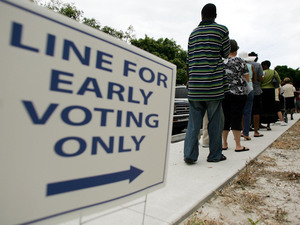
People wait in line at the Boynton Beach Civic Center in Palm Beach County, Fla., for early voting, on Oct. 22, 2008. That year, early voting helped Barack Obama carry the state. Now, Republicans want to shorten the number of days Floridians can vote early.It’s still a year and a half until the presidential election, but members of Florida’s Legislature are already jockeying over who will be able to vote and how.

Republicans — who control both Florida’s House and Senate — are sponsoring bills that would restrict the ability of third-party groups to conduct voter registration drives. Another measure would slash the number of days allotted for early voting.

Democrats and independent voter groups say it’s all about politics.