
Florida: Florida counties brace for impact of new election-reform law | Electionline Weekly

Following the disastrous 2000 election and the implementation of the Help America Vote Act of 2002 (HAVA), elections supervisors in the state of Florida have been faced with a host of election administration rules and regulation changes every election cycle and 2012 appears like it will be no different.

Today, Gov. Rick Scott (R) signed sweeping election-reform legislation that will decrease the length of time for early voting, create more reasons to cast a provisional ballot and will alter how third-party registrations are conducted.

“As a Supervisor of Elections in Florida, I had secretly hoped that there would be little to no legislation introduced this year that would have a major impact on elections and election administration,” said Linda Harrington, Lee County supervisor of elections.  “We have been dealing with major changes to our election processes and equipment on both the federal and state level since 2002 when the Help America Vote Act was enacted.  I don’t think any of us anticipated the enormity of these legislative changes to the Election Code.”

Florida: Protests grow as Governor considers Florida elections bill | Orlando Sentinel

Update May 20: Judge: No early voting Sunday in Miami-Dade election | MiamiHerald.com.

Gov. Rick Scott has yet to sign a sweeping elections bill that rewrites much of the state’s voting laws, but the measure is already having repercussions in a South Florida mayoral race – and drawing challenges from Democrats in Florida and in Washington.

Elections officials in Miami-Dade have canceled early voting hours for Sunday in anticipation that Scott will sign the bill by Saturday, his deadline for a decision. Among other things, the bill prohibits early voting three days before an election; the Miami-Dade mayoral primary is next Tuesday.

North Carolina: Shorter early voting costlier | The Charlotte Observer

A bill that would shorten North Carolina’s early voting period would create longer lines at the polls and increase the cost of elections, the executive director of the state elections board said Wednesday.

Gary Bartlett’s comments came in a memo shortly after the House narrowly passed the measure that would reduce the current 21/2-week early voting period by a week, even while opening polls for a second Saturday before the election. The Republican-backed bill passed 60-58, largely along party lines.

Ohio: Ohio House passes election reforms – Democrats call bill an attempt to hinder their voters | The Columbus Dispatch

Elections officials could no longer send absentee ballot applications to all Franklin County voters, and the time for in-person early voting would be significantly reduced under an elections overhaul bill that passed the House today along party lines.

The sweeping bill, which also would attempt to lessen the need to cast provisional ballots, allows election boards to save money through bulk purchasing, and would let voters update registrations online — a “significant move in the right direction to unify our electoral process in the state of Ohio,” said Rep. Robert Mecklenborg, R-Cincinnati.

Florida: Battle Looms Over Florida’s Elections Bill | Sunshine State News

A highly controversial bill, passed by the Legislature earlier this month and expected to be signed into law by Gov. Rick Scott at any moment, could mean all the difference in the 2012 presidential election.

State Republican lawmakers who passed HB 1355 say they want to eliminate the potential for voter fraud, but Democrats claim the bill is nothing more than a partisan pre-election attack aimed at disenfranchising left-leaning voters, and note that there have been no serious cases of voter fraud in Florida during the past two election cycles.

Georgia: Georgia bill limiting early voting become law | Forsyth News

Two bills authored by District 23 state Rep. Mark Hamilton were recently signed into law by Gov. Nathan Deal.  House Bill 92 shortens the early voting period from 45 to 21 days as a cost-saving measure.

It also requires polls to be open on one Saturday during the early voting period to improve access for those whose work schedules don’t allow them to vote on weekdays.

Florida: Department of Justice will look into Florida elections law changes | Post on Politics

The U.S. Department of Justice will “carefully consider” changes to Florida’s elections laws under a bill Gov. Rick Scott is expected to sign into law this week.

U.S. Sen. Bill Nelson complained to the feds before the bill was passed that the measure would impose severe restrictions on Floridians’ voting rights. Democrats are convinced the measure is aimed at suppressing Democratic votes in next year’s presidential election in the swing state considered crucial by both parties. Nelson drew flak with his comments at the time likening the fight against the elections overhaul to the the years-long covert operation that culminated in the death of Osama bin Laden.

Ohio: Ohio Secretary of State chats up possible voting changes – ending “Golden Week” | newsnet5.com

The Ohio Secretary of State has a goal for 2012, to not be in the national spotlight. “That’s why you see us in early 2011 working through all the issues that we foresee on our doorstep in November of 2012,” said Jon Husted. “The last thing in the world that I ever want to be is the focus of any 2012 election.”

So Hosted is busy getting ready to institute changes that will likely come from two bills making their way through the state house and senate that will change the way people vote in Ohio. “For over 200 years, we voted on Tuesdays and now we’re trying to, over the last 10 years, perfect this early-voting process,” Husted said.

North Carolina: Bid to cut North Carolina early-voting has political tinge | Connecticut Post

Politically tinged legislation to cut North Carolina’s early voting period by a week hinges on Democratic worries they’ll lose voters and Republican insistence the shorter time is more efficient. The state House is scheduled to vote on the measure Monday. A tentative vote last week passed by a close margin, meaning a veto by Democratic Gov. Beverly Perdue could block the measure.

More than 2.4 million voters — 55 percent of the electorate — cast ballots at one-stop sites in the 2008 general election marked by Barack Obama’s presidential victory. The first Democrat to receive North Carolina’s electoral votes in 32 years was powered in large part by a 300,000-vote advantage over Republican John McCain during early voting.

Florida: New Florida laws may face legal challenges | TBO.com

The American Civil Liberties Union of Florida has hired two more lawyers and is planning to add another to help handle an expected workload increase resulting from the Republican-led Legislature’s recently ended session.

The ACLU, unions and some liberal and nonpartisan groups are gearing up for potential legal challenges to legislation as well as at least one of Gov. Rick Scott’s executive orders. They are reviewing measures that they say violate privacy, free speech, voting, due process, collective bargaining and other constitutional rights and requirements.

“I didn’t realize at the time of the election that when Gov. Scott said, ‘Let’s get to work,’ he was referring to the lawyers in the state, but that seems to be the way it’s working out,” Tallahassee lawyer Ron Meyer said. His clients include the Florida Education Association — the statewide teachers union — which is considering challenges to several measures.

“This legislative session has been maybe the biggest disaster for personal freedoms and human rights, and the list is long,” said Howard Simon, ACLU of Florida’s executive director. House Speaker Dean Cannon, R-Winter Park, declined to comment, citing the pending lawsuits. Calls to Scott and Senate President Mike Haridopolos, R-Melbourne, were not immediately returned.

Full Article: New Florida laws may face legal challenges | TBO.com.

North Carolina: North Carolina House panel moves to cut early voting | WRAL.com

On a party-line vote, the House Elections committee voted today to shorten the early voting period from 18 days to 11 days. Early or “one-stop” voting has become increasingly popular over the past few years. A recent study by Catawba College professor Dr. Michael Bitzer found that 60% of the ballots cast in NC’s 2008 general election were cast before Election Day, up from 30% in 2004.

Bitzer also found Democrats were more likely to use early voting than Republicans. The NC Free Enterprise Foundation has a nice writeup here. “We’re not trying to do away with early voting in any way,” H658 sponsor Bert Jones, U-Rockingham, told the committee. “The question is, how many election days should we have in North Carolina?”

North Carolina: Cut to early voting advances in North Carolina House | JournalNow.com

North Carolina residents would have one week less to cast ballots before state and local elections in legislation narrowly approved by a House committee on Wednesday. Supporters said the proposal would save money, but opponents argue it would discourage citizens — particularly Democrats — from voting.The House Elections Committee voted 16-14 to delay the start of early voting from the third Thursday before an election to the second Thursday, curbing what’s been a popular method for casting ballots begun with the 2000 elections.

Rep. Bert Jones, the only unaffiliated member of the legislature and a primary bill sponsor, said the bill would save nearly $2,000 per one-stop voting site statewide and save more money for candidates who now must campaign to get people to the polls for up to 18 days. The bill would reduce that maximum to 11 days. He presented a chart showing relatively light turnout during the first current week of early voting since the 2008 primary.

Florida: Senator Nelson blasts Florida state election reform | The News Herald

If Gov. Rick Scott signs recently passed election reform into law, U.S. Sen. Bill Nelson says he will lobby for a federal investigation of the new rules. The sweeping changes to the state’s election code have raised skepticism from supervisors of elections and nonpartisan voter groups worried that the reduced number of early voting days, stringent new rules on third-party voter registration drives and new change-of-address requirements will disenfranchise voters by making the process less accessible. Supporters of the bill contend the measures are necessary to crack down on voter fraud.

The bill was signed by legislative officers and delivered to Scott on May 6 for his signature. Lane Wright, a spokesman in the governor’s office, said the bill is not a priority for Scott, who is intensely focused on job creation, and the governor has not decided if he will sign the measure into law.

Florida: Collier, state League of Women Voters to stop voter registrations, consider legal action due to election bill » Naples Daily News

A national organization aimed at encouraging participation in government has said it will no longer register Floridians to vote after state lawmakers approved a sweeping overhaul to the state’s election code.

Lydia Galton, president of the League of Women Voters of Collier County and director of the state board, said Monday that the Florida association decided to immediately stop voter registration efforts across the state after passage of House Bill 1355.

“While the league remains committed to empowering an active and informed citizenry, we cannot and will not place thousands of volunteers at risk, subjecting them to a process in which one late form could result in their facing financial and civil penalties,” she said. “By passing House Bill 1355, the legislature has declared war on voters.”

Florida: Opponents blast Florida election reform bill | wtsp.com

If you’re planning on getting married and changing your name, or moving to another part of Florida, pay attention. The way you vote may be impacted. An election reform bill that sailed through the House and Senate, despite intense debate, is headed for Governor Scott’s desk.

It aims to change a number of things about Florida’s election code, including a forty-year-old law that allows voters to change their address and/or name at the polls on election day. If signed into law, voters wishing to make those changes will have to vote by provisional ballot, which some fear may not be counted.

Florida: Florida legislature OKs elections-law overhaul | MiamiHerald.com

After dueling allegations that it was either a “protection against voting fraud” or a “disenfranchisement act,” Florida lawmakers on Thursday approved a 157-page overhaul of the state’s elections code.

The House voted 77-38 along party lines to pass the bill (HB 1355); the Senate had voted 25-13 earlier in the day. Paula Dockery of Lakeland and Mike Fasano of New Port Richey were the only Senate Republicans to break ranks and vote against it. The measure now goes to Gov. Rick Scott, who is expected to sign it into law. Among other provisions, the bill reduces early voting time to one week and requires groups that sign up voters to register with the state. 

Editorials: Charles Zelden: Changes in election law remind us of another era | floridatoday.com

Recent events remind us that Florida truly is a Southern state. Legislation that would radically revise Florida’s election laws was passed Thursday by the Senate SB 1355 and now is headed back to the House for likely fast-tracked approval.

These changes include: shrinking the early-voting period by half, from two weeks to one, removing provisions in place since the 1970s that allow registered voters to change their names and addresses in elections records on Election Day and still vote using a regular ballot, allowing poll watchers to challenge the legitimacy of voters, which would automatically require those voters to fill out provisional ballots, which are less likely to be counted than standard ballots, and severely restricting the ability of grass-roots groups to register new voters by enacting new restrictions and fines.

Florida: Bill Nelson Warns Rick Scott to Veto Election Bill or Face a Federal Investigation | Broward Palm Beach News

US Senator Bill Nelson (D-FL)Although it seems like Gov. Rick Scott will make the bold and progressive move of banning bestiality, he still plans to screw voters. The election overhaul bill, which many see as backdoor disenfranchisement, cruised through the Legislature and now awaits the governor’s signature. Throughout the legislative session, Scott not only supported the bill verbally but also led by example as he and his Cabinet brought back Jim Crow-style voting laws.
Well, it’s about time that someone reminded Capo Scott about the Voting Rights Act, which was meant to ensure every citizen’s right to vote by protecting them from states that exploited loopholes in the 15th Amendment. Section 5 of the Voting Rights Act requires federal preclearance of any election law that could discriminate against minority voters. Section 5 covers five counties in Florida.

The NAACP and ACLU have already asked the Justice Department to investigate Florida’s potential violation of the Voting Rights Act. Now, finally, U.S. Sen. Bill Nelson has done the same.

Nelson railed against the bill all week and barely acknowledged the feckless castigation that followed his remark about Osama Bin Laden’s death. After both chambers of the Legislature approved the bill yesterday, Nelson admonished Scott in a letter in which he threatened to seek a federal investigation if Scott signs the bill into law.


Full Article: Bill Nelson Warns Rick Scott to Veto Election Bill or Face a Federal Investigation – Broward Palm Beach News – The Juice.

Florida: Florida Senate passes controversial elections bill | Orlando Sentinel

The Florida Senate passed a massive overhaul of state election law by a 25-13 vote Thursday that would make changes to early voting, limit a voter’s ability to change his or her address or name at the polls and set up a presidential primary committee.

Democrats argued against the legislation though and said it would disenfranchise voters, particularly college students who frequently take advantage of the registration changes at the polls because they move so often. “We have young people who would love to register to vote,” said Sen. Gwen Margolis, D-Miami.

Guam: Early in-office voting, machines debated in Guam | Pacific Daily News

Lawmakers yesterday debated two bills that could affect future island elections — ending the recently approved process for early in-office voting and paving the way for the return of controversial electronic voting machines. Lawmakers debated another election bill by Respicio, which would allow for the use of electronic voting machines, provided the machines print a “voter-verified paper ballot” which the voter can double-check before placing into a ballot box.

Respicio in 2006 wrote a law banning the use of electronic voting machines until several conditions are met, including training and safeguards for accuracy. The Election Commission spent nearly half a million dollars in federal election assistance funding to buy 116 Ivotronic electronic voting machines, according to Pacific Daily News files.

Florida: Nelson blasts Florida Legislature’s 2012 election-law fixes | MiamiHerald.com

Democratic U.S. Sen. Bill Nelson blasted state Republican lawmakers Monday for an election law overhaul that he says will block college students and military personnel from having their votes counted next year when he and President Barack Obama both seek re-election.

Then Nelson waded into a controversy of his own when he suggested the U.S. special forces that killed al-Qaida leader Osama bin Laden could be blocked from voting if the Legislature passes the bill.

North Carolina: GOP proposal would cut a week from early voting | CharlotteObserver.com

Heading into a presidential election in which North Carolina could be pivotal, a new Republican-backed bill would curtail early voting in the state and bar new voters from registering at the polls. The Senate bill introduced last week would shrink the early-voting period by at least a week, end it on Sundays and stop so-called “same-day registration.”

“We were just trying to minimize the time early voting polls were open … so the expense is not so great for local election boards,” Sen. Jim Davis, a Macon County Republican who sponsored the bill, said Monday. “Everybody who wants to vote still can vote.” It’s unclear how much support the bill has, even among Republicans. The bill is still in a Senate committee and has a long way to go before it could become law.

Editorials: Tonyaa Weathersbee: Politics behind GOP’s voting changes | jacksonville.com

If anyone needs a clue as to why the state’s Republican-dominated Legislature is making proposals that puts early voting in its cross hairs, one place to look might be Time magazine’s Oct. 30, 2008 issue.

In it was a piece titled “How Early Voting Could Cost McCain Florida.” It detailed how early-voting Democrats, many of them energized by the candidacy of Barack Obama, were outnumbering Republicans at early voting sites by more than 20 percentage points.

Florida: With presidential election looming, Florida election law rewrite moves forward | jacksonville.com

With a fast-approaching presidential election expected to bring more than 8.5 million Floridians to the polls, the Legislature is battling over sweeping changes to nearly every aspect of state election law.

Supporters tout the changes as fighting fraud. Opponents say they are disenfranchising. And the people charged with counting ballots wonder why lawmakers are trying to reinvent the wheel in the first place.

Florida: Florida GOP Pushes Controversial Changes To Voting Laws | NPR


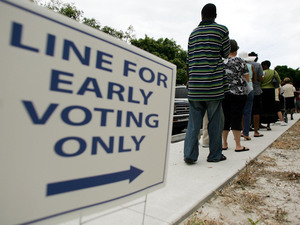
People wait in line at the Boynton Beach Civic Center in Palm Beach County, Fla., for early voting, on Oct. 22, 2008. That year, early voting helped Barack Obama carry the state. Now, Republicans want to shorten the number of days Floridians can vote early.It’s still a year and a half until the presidential election, but members of Florida’s Legislature are already jockeying over who will be able to vote and how.

Republicans — who control both Florida’s House and Senate — are sponsoring bills that would restrict the ability of third-party groups to conduct voter registration drives. Another measure would slash the number of days allotted for early voting.

Democrats and independent voter groups say it’s all about politics.

Florida: Florida House passes elections law overhaul | St. Petersburg Times

The Florida House passed a sweeping overhaul of election laws Thursday that Republicans say will streamline voting machinery and Democrats say will make it harder for people to vote in the nation’s biggest battleground state in 2012.

Passage on a 79-37 party-line vote followed two days of intensely partisan debate — a harbinger of next year’s presidential election when Florida’s newly increased 29 electoral votes and all 160 legislative seats will be at stake in a pivotal reapportionment year. But the closest that any Republican lawmaker came to stating the obvious — invoking President Barack Obama’s name — was a passing reference to preventing “the Chicago method” of voting more than once.

Editorials: Election bills rap democracy: Public short-served by GOP legislation | OrlandoSentinel.com

Time to stop calling the gang running Florida’s government conservative. They’re busy concocting a liberal dose of new regulations that would serve their fortunes first, and Floridians dead last.

It amounts to their ripping apart election laws that have made it easier for Floridians to vote, and replacing them with laws that could stack the deck — election outcomes — in the Republicans’ favor.

Florida: Florida Legislature passes dramatic overhaul of state election law | South Florida Sun-Sentinel.com

Florida lawmakers passed a dramatic overhaul of state election law Thursday night, a move that GOP legislators say will bring integrity to the process and one that Democrats counter will disenfranchise voters across the state.

The measure, a major rewrite to the laws that govern the state’s elections, passed 79-37. Among other things, the measure (HB 1355) would limit voters’ ability to change their address at the polls, change third-party voter registration rules and make it more difficult for citizen groups to put amendments on the ballot.

Editorials: Howard Troxler: Florida Legislature cracks down on … voting? | St. Petersburg Times

Having solved all other problems, the Florida Legislature now turns to the most dangerous threat of all …Voting. No kidding. The 2011 Legislature is considering, and its committees have approved so far, bills that would:

• Cut Florida’s early-voting period (nearly one out of five ballots were cast early in 2010) from two weeks to one.
• Bar anyone who has moved or changed a name, such as newly married women, from updating their information at the polls on Election Day and receiving a regular ballot. They would have to cast “provisional” ballots instead.
• Crack down on, and expand penalties for, groups that try to register new voters — which used to be considered an all-American activity.
• Make it even harder for citizens to change the Florida Constitution by setting an earlier expiration date for petition signatures.