Editorials: Jay Weiner: Voter ID issue advances at Capitol, but facts continue to get in the way | MinnPost

Jay WeinerA funny thing happened recently to the U.S. Department of Homeland Security on its way to nailing an alleged illegal voter. Homeland Security’s Immigration and Customs Enforcement (ICE) investigative arm found that clerical mistakes are sometimes made and that people can be accused of trying to vote illegally when they actually didn’t.

The investigators, with the aid of Hennepin County elections officials, learned that clerks at the state Department of Vehicle Services can wrongly check off boxes and that workers at voting locations can incorrectly mark a voter roster.

Indiana: Judge orders recount panel to explain Charlie White lag | The Indianapolis Star

A Marion County judge has ordered the IndianaRecount Commission and the State Republican chairman to explain why they haven’t moved quickly to resolve Democrats’ challenge to Charlie White’s eligibility to serve as secretary of state.

On April 7, Marion Circuit Court Judge Louis F. Rosenberg ruled the Democrats’ challenge is valid and told the Recount Commission to move forward with it quickly.

Florida: Proposed bills would make voting harder for many Floridians | Sun Sentinel

College students seeking to vote at their campus precinct will find it harder to do. So will women who’ve changed their name but not re-registered before an election. The time for early voting would be cut from 14 days to six.

Groups like the League of Women Voters will find it tougher to register voters. And citizens attempting to amend the constitution will have to gather more than 600,000 signatures in two years instead of four.

The Voting News Daily: Oak Ridge, spear phishing, and internet voting, Voter Files Altered in New Mexico

Oak Ridge, spear phishing, and internet voting – Freedom to Tinker

Oak Ridge National Labs (one of the US national energy labs, along with Sandia, Livermore, Los Alamos, etc) had a bunch of people fall for a spear phishing attack (see articles in Computerworld and many other descriptions). For those not familiar with the term, spear phishing is sending targeted emails at specific recipients, designed to have them do an action (e.g., click on a link) that will install some form of software (e.g., to allow stealing information from their computers). This is distinct from spam, where the goal is primarily to get you to purchase pharmaceuticals, or maybe install software, but in any case is widespread and not targeted at particular victims. Spear phishing is the same technique used in the Google Aurora (and related) cases last year, the RSA case earlier this year, Epsilon a few weeks ago, and doubtless many others that we haven’t heard about. Targets of spear phishing might be particular people within an organization (e.g., executives, or people on a particular project). Full Article

NM: Thousands of voter files altered; Bernalillo County clerk demands SOS restrict database access – Veritas NM.com

A few days after New Mexico Secretary of State Dianna Duran notified all 33 county clerks that their biennial voter purge would be canceled this year, Deputy Bernalillo County Clerk Robert Adams made a disturbing discovery — 44,601 county files stored on the state’s voter registration database had been accessed and altered. Accustomed to spending long hours in front of his computer, Adams says he was shocked to learn informational “flags,” which are attached to voter files after mail is returned by the U.S. Postal Service as undeliverable, had simply vanished on Valentine’s Day. After securely logging on to the database, known as PowerProfile, Adam’s heart began beating a little faster as he started considering worst-case scenarios. He needed to know what happened before the Bernalillo County Board of Voter Registrations was convened the third Monday of March, the date required by state statute. Adams worried a criminal might have breached a government intranet connection with the goal of stealing voters’ social security and driver license numbers and other sensitive personal identification information, including voters’ dates of birth and addresses. Later the same chilly February morning, however, Adams determined the flags had been deleted by an unauthorized technician at Nebraska-based Elections Systems and Software (ES&S) without his, or County Clerk Maggie Toulouse Oliver’s written or verbal permission. Full Article

Nigeria: International Election Observer Declares Nigeria Presidential Vote Credible | VOAnews.com

The leader of an observer mission at last weekend’s presidential election in Nigeria says the vote was largely free and fair. It was a significant improvement over the 2007 general elections, said Robin Carnahan of the U.S.-based National Democratic Institute [NDI], and the secretary of state of the U.S. state of Missouri. Most observers described those earlier polls as flawed.

“The presidential and National Assembly elections represent a step forward from seriously flawed elections of the past,” said the NDI in a statement. It said they hold the promise of setting a new standard for integrity in Nigeria’s electoral process.

Tennessee: GOP moves to repeal Tennessee paper ballot law | The Tennessean

A plan to require paper ballots in next year’s elections is on the verge of being repealed, the latest in a series of actions taken by Republicans in the state legislature to rewrite Tennessee election laws.

State representatives are trying to reverse most of a 2008 law that called for the replacement of electronic voting machines across the state with paper ballots read by computerized scanners. The move would kill off a plan that supporters say would create a verifiable record of votes but opponents say will be costly and open to tampering.

New Mexico: Thousands of voter files altered in New Mexico; clerk demands Secretary of State restrict access | Veritas NM.com

A few days after New Mexico Secretary of State Dianna Duran notified all 33 county clerks that their biennial voter purge would be canceled this year, Deputy Bernalillo County Clerk Robert Adams made a disturbing discovery — 44,601 county files stored on the state’s voter registration database had been accessed and altered.

Accustomed to spending long hours in front of his computer, Adams says he was shocked to learn informational “flags,” which are attached to voter files after mail is returned by the U.S. Postal Service as undeliverable, had simply vanished on Valentine’s Day.

Maryland: $3.41M Settlement with Premier Election Solutions Over Voting Machine Security Issues | Southern Maryland Headline News

Attorney General Douglas F. Gansler on Wednesday announced the settlement of a claim against Premier Elections Solutions, formerly known as Diebold. The settlement, negotiated by the Office of Attorney General, will be worth more than $3 million to the State.

In 2008, the Attorney General, on behalf of the State Board of Elections, brought a claim against Diebold to recoup costs that the State incurred to remedy security issues that had arisen with the Diebold machines.

Florida: With presidential election looming, Florida election law rewrite moves forward | jacksonville.com

With a fast-approaching presidential election expected to bring more than 8.5 million Floridians to the polls, the Legislature is battling over sweeping changes to nearly every aspect of state election law.

Supporters tout the changes as fighting fraud. Opponents say they are disenfranchising. And the people charged with counting ballots wonder why lawmakers are trying to reinvent the wheel in the first place.

Colorado: Are Denver’s elections costing too much? | KWGN

Four candidates are running for Clerk & Recorder in Denver, and one of them, Jacob Werther, is claiming the all-mail ballot election is costing the City too much. “I’m thinking about four dollars a ballot,” said Werther.  “When you factor in the paper and the labor involved in handling 290-thousand ballots it’s about 1.2 million dollars.”

He says if the city would go to a full Ballot on-demand system, where ballots are printed out when voters show up at the polls, this election could have come in for about $600,000 and that includes 60 polling places with eight judges at each location.

Arizona: Tucson’s mail-in election may violate state | KOLD.com law

Tucson city leaders voted two weeks ago to hold all mail elections. It was a way to save money for a cash starved city and increase voter turnout. But Republicans at the state legislature have different ideas.

After the city vote, the lawmakers inserted language in SB 1331 which in essence says Tucson can’t do that. Any other city in the state can hold mail in elections, just not Tucson.

Wisconsin: Count on some chaos in state Supreme Court recount | JSOnline

This is what a recount looks like: An indoor sports arena is filled with poll workers from every municipality in Milwaukee County, each in their own area. At each station, poll workers examine and count ballots one by one. And as they count, campaign volunteers, attorneys and journalists watch their every move – with the campaign representatives sometimes challenging the poll workers’ decisions – while sheriff’s deputies stand guard.

It could be the biggest show in Wisconsin. And, with a few variations, it opens next week in every county in the state.

Tennessee: Sumner County leaders oppose possible paper ballot mandate in Tennessee | The Tennessean | tennessean.com

Members of the Sumner County Commission recently voted to send a proposal to state legislators to either repeal or fund a bill currently being considered that mandates the use of paper ballots in local elections.

“We just purchased new machines that are electronic, and if they mandate paper ballots we’ll have to go to a new system,” County Executive Anthony Holt said. “It could be in the range of $300,000 to buy the new required scanning machines and have them stored. That’s going to be a huge fiscal impact.”

Verified Voting Blog: Oak Ridge, spear phishing, and i-voting

Oak Ridge National Labs (one of the US national energy labs, along with Sandia, Livermore, Los Alamos, etc) had a bunch of people fall for a spear phishing attack (see articles in Computerworld and many other descriptions). For those not familiar with the term, spear phishing is sending targeted emails at specific recipients, designed to have them do an action (e.g., click on a link) that will install some form of software (e.g., to allow stealing information from their computers). This is distinct from spam, where the goal is primarily to get you to purchase pharmaceuticals, or maybe install software, but in any case is widespread and not targeted at particular victims. Spear phishing is the same technique used in the Google Aurora (and related) cases last year, the RSA case earlier this year, Epsilon a few weeks ago, and doubtless many others that we haven’t heard about. Targets of spear phishing might be particular people within an organization (e.g., executives, or people on a particular project).

In this posting, I’m going to connect this attack to Internet voting (i-voting), by which I mean casting a ballot from the comfort of your home using your personal computer (i.e., not a dedicated machine in a precinct or government office). My contention is that in addition to all the other risks of i-voting, one of the problems is that people will click links targeted at them by political parties, and will try to cast their vote on fake web sites. The scenario is that operatives of the Orange party send messages to voters who belong to the Purple party claiming to be from the Purple party’s candidate for president and giving a link to a look-alike web site for i-voting, encouraging voters to cast their votes early. The goal of the Orange party is to either prevent Purple voters from voting at all, or to convince them that their vote has been cast and then use their credentials (i.e., username and password) to have software cast their vote for Orange candidates, without the voter ever knowing.

The Voting News Daily: Florida GOP stacks the election deck, Minnesota House Speaker admits that voting is a right after all

FL: Election bills rap democracy: Public short-served by GOP legislation – OrlandoSentinel.com

Time to stop calling the gang running Florida’s government conservative. They’re busy concocting a liberal dose of new regulations that would serve their fortunes first, and Floridians dead last. It amounts to their ripping apart election laws that have made it easier for Floridians to vote, and replacing them with laws that could stack the deck — election outcomes — in the Republicans’ favor. Forget for the moment that Republicans already control two-thirds of the Legislature. And the governor’s office. And the Cabinet. And 19 of Florida’s 25 congressional seats. The Legislature has forgotten all of that. If Republican lawmakers manage to reconcile the House elections bill that passed on Thursday with the Senate elections bill that’s expected to pass next week, they’ll have pressed their advantage by giving Floridians… Far less time to vote. By most measures, the state’s two-week early voting procedure has been fabulously successful, with about one-in-five voters opting for it. Full Article

MN: Voting is indeed a right, Zellers agrees after radio show error | StarTribune.com

House Speaker Kurt Zellers found himself in a constitutional bind on Thursday after saying that voting was a privilege, not a right. The Maple Grove Republican made the comment Wednesday night during a local radio show, “The Late Debate.” He recanted his words on Thursday, saying he had misspoken. The gaffe came amid a discussion of legislation that would require voters to show photo identification at the polls. That bill is nearing a vote after months of hearings. “When you go to even a Burger King or a McDonalds and use your debit card, they’ll ask you to see your ID,” Zellers said sometime after 11 p.m. “Should we have to do that when we vote, something that is one of the most sacred — I think it’s a privilege, it’s not a right. Everybody doesn’t get it, because if you go to jail or if you commit some heinous crime your rights are taken away. This is a privilege.” The right to vote is explicitly referenced in several constitutional amendments, in addition to the Voting Rights Act of 1965. “I fully understand it’s a right we all have,” Zellers said on Thursday. “I probably should have said it a little bit better at that late hour at night.” His comments drew a quick rebuke from DFLers, some of whom believe the voter ID legislation will hinder seniors and college students from voting. Full Article

Florida: Florida GOP Pushes Controversial Changes To Voting Laws | NPR


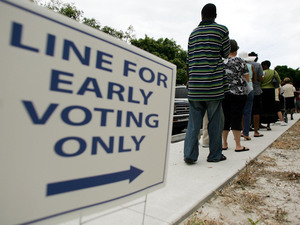
People wait in line at the Boynton Beach Civic Center in Palm Beach County, Fla., for early voting, on Oct. 22, 2008. That year, early voting helped Barack Obama carry the state. Now, Republicans want to shorten the number of days Floridians can vote early.It’s still a year and a half until the presidential election, but members of Florida’s Legislature are already jockeying over who will be able to vote and how.

Republicans — who control both Florida’s House and Senate — are sponsoring bills that would restrict the ability of third-party groups to conduct voter registration drives. Another measure would slash the number of days allotted for early voting.

Democrats and independent voter groups say it’s all about politics.

South Carolina: Voting Machine Critics Get Their Day in the South Carolina Senate | Free Times

After a Senate panel heard testimony on April 14 from a handful of election watchdogs critical of the state’s system of electronic voting machines, a rather testy exchange took place in the hallway. “You guys have a tough job,” said USC computer scientist Duncan Buell to Chris Whitmire, the spokesman for the South Carolina State Election Commission. “You have a really tough job, but you’re in deep denial about reality.”

Buell has blasted the state agency in charge of South Carolina’s voting machines for some time. In February, after an independent audit he conducted with another computer expert, the two compiled a report that illustrated how the agency failed to count more than 1,000 votes in the November elections in Richland County alone.

North Dakota: Jury still out in voting centers issue | Bismarck Tribune

“It was a valuable experiment. We learned what worked well and what things didn’t,” said Burleigh County Auditor Kevin Glatt about using voting centers for this week’s special election on Bismarck’s smoking ban. One center was placed at the Bismarck Civic Center and one at the VFW Sports Arena.

There are now 35 voting precincts and sites throughout the county; of those, 24 are in Bismarck’s borders. Glatt downsized voting sites for the special election as a test run for using vote centers in the future.

New Jersey: Advocacy groups, students argue N.J. should allow voter registration on Election Day | NJ.com

The times have changed, but a key part of the state’s election law is still stuck in the past, according to a coalition of students and advocacy groups that filed a challenge to New Jersey’s voter-registration law today.

Instead of requiring 21 days to process a voter registration, the state should get with the times and allow people to sign up on Election Day, the plaintiffs argued. Thousands of residents are locked out of the voting booth every year because they don’t file their paperwork on time, they said, and the law is especially cumbersome for highly mobile people like college students.

Hawaii: Honolulu City Council: No Instant Runoff Voting | Honolulu Civil Beat –

Un-American, ill-advised and expensive. The Honolulu City Council has a long list of reasons as to why state lawmakers ought to kill a move meant to improve its current voting system.

Council members on Wednesday passed a resolution urging state lawmakers not to pass House Bill 638, which would bring instant runoff voting to Honolulu and other counties. The measure is two steps away from passing with state representatives set to discuss it in a conference committee Thursday morning.

Florida: Florida House passes elections law overhaul | St. Petersburg Times

The Florida House passed a sweeping overhaul of election laws Thursday that Republicans say will streamline voting machinery and Democrats say will make it harder for people to vote in the nation’s biggest battleground state in 2012.

Passage on a 79-37 party-line vote followed two days of intensely partisan debate — a harbinger of next year’s presidential election when Florida’s newly increased 29 electoral votes and all 160 legislative seats will be at stake in a pivotal reapportionment year. But the closest that any Republican lawmaker came to stating the obvious — invoking President Barack Obama’s name — was a passing reference to preventing “the Chicago method” of voting more than once.

Colorado: ES&S voting system report raises red flags | Center Post Dispatch

When Secretary of State Scott Gessler held his town hall in Saguache March 15, he told county residents that he had requested the distributor of the M650 voting machine to provide him with a report of Saguache election records.

On March 28, Elections Systems and Software (ES&S) sent Gessler a copy of the M650’s Unity software system log and a report on the election tabulation issues for his office to examine. The system log reported the activity on the election reporting software resident on the laptop used by County election staff.

Editorials: Election bills rap democracy: Public short-served by GOP legislation | OrlandoSentinel.com

Time to stop calling the gang running Florida’s government conservative. They’re busy concocting a liberal dose of new regulations that would serve their fortunes first, and Floridians dead last.

It amounts to their ripping apart election laws that have made it easier for Floridians to vote, and replacing them with laws that could stack the deck — election outcomes — in the Republicans’ favor.

Malaysia: Election Commission: Returning officer spot on in rejecting recount | BorneoPost Online

Returning Officer (RO) for N65 Senadin Chai Ko Het’s rejection of Parti Keadilan Rakyat (PKR)’s request for a recount after the completion of the official addition of votes at the Centre for the Official Addition of Votes, was in accordance with the law.

Chai was right when he acted in accordance with subregulation 23A (1), subregulation 25 (13) and subregulation 25D (5A) of the Elections (Conduct of Elections) Regulations 1981 (R81), said Sarawak Election Commission (EC) through a press statement signed by its director Datu Takun Sunggah yesterday.

Egypt: India to provide EVMs to Egypt | Hindustan Times

There may be lot of debate in India over efficacy of the Electronic Voting Machines but Egypt, which is holding elections after Hosni Mubarak’s ouster, is willing to try the “wonder machine — the EVMs” — in the country wide polls later this year. Egypt will not be the first country to use Indian

EVMs. They have been successfully deployed in Afghanistan general elections. The Election Commission has also provided inputs to Nepal, Bhutan, Ethopia and Mexico on use of EVMs in making the election process more fair and transparent.

Editorials: New York Times: Do You Think It’s Because They Liked Florida’s Election?

House Republicans are seeking to abolish the federal Election Assistance Commission — as if the nation is fully recovered from the hanging-chad nightmare of 2000. The 9-year-old commission was created in bipartisan Congressional resolve to repair the nation’s crazy quilt of tattered election standards and faltering machinery.

The commission was charged with upgrading the mechanics of voting by certifying electoral equipment, channeling needed federal aid and guidance to states, and developing a national mail-in voter registration system. After a slow start, it has made progress as the 2012 elections loom. But there is still a lot more that needs repairing.

Wisconsin: The Badger Herald: GAB denies Kloppenburg’s independent investigator request for recount

After announcing she would request a statewide recount in the Supreme Court election earlier this week, challenger JoAnne Kloppenburg and incumbent Justice David Prosser argued in court Thursday to reach a decision as to how the recount would be done. Dane County Circuit Court Judge Richard Ness approved a recount procedure that would include a hand recount in 31 counties and allow for electronic voting equipment for the rest of Wisconsin.

Since declaring victory in the race Monday, Prosser’s campaign has been outspoken against having a recount. But Kloppenburg’s campaign manager Melissa Mulliken said she agreed with the judge’s decision.

Minnesota: Voting is indeed a right, Zellers agrees after radio show error | StarTribune.com

House Speaker Kurt Zellers found himself in a constitutional bind on Thursday after saying that voting was a privilege, not a right. The Maple Grove Republican made the comment Wednesday night during a local radio show, “The Late Debate.” He recanted his words on Thursday, saying he had misspoken.

The gaffe came amid a discussion of legislation that would require voters to show photo identification at the polls. That bill is nearing a vote after months of hearings.

Indiana: Measure Would Allow Daniels To Appoint New Secretary of State | WFPL News

The Indiana Senate has approved a measure that would allow Republican Governor Mitch Daniels to appoint a new secretary of state if current officeholder Charlie White is found to be ineligible. Democrats are calling it a blatant power grab.

White, a Republican, is under indictment on voter fraud charges. Democrats are now challenging his eligibility. Current state law requires runner-up Democrat Vop Osili to take office if White is ineligible.